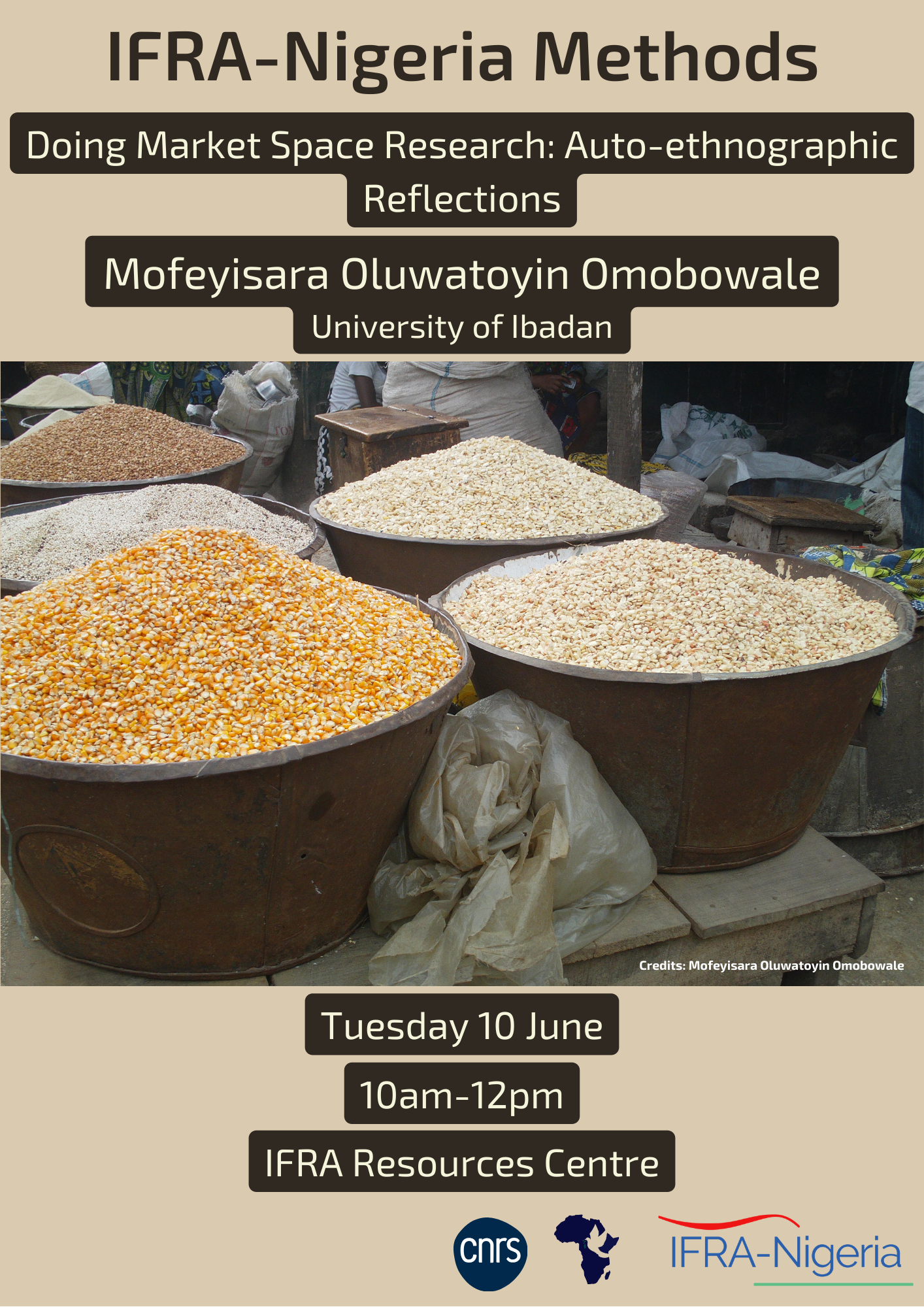
 Join us on 10 June, between 10am and 12pm for our latest Methodological Seminar with Mofeyisara Oluwatoyin Omobowale from the Institute of Child Health in the University of Ibadan. She will talk on "Doing Market Space Research: Auto-ethnographic Reflections". The market space is one of the major public spaces in Nigeria that is central to not only economic development but also societal growth and wellbeing. For the Yoruba of South West Nigeria transcends economic activities. The space is potent for diverse disciplinary research, including anthropology, economics, sociology, geography and public health among others.
This presentation is on the techniques of data collection in market studies. The market is a community within the society, it is rowdy, but organized, chaotic, yet structured with numerous opportunities for studies. This presentation aims to reflectively discuss how she conducted market research over the years. Mofeyisara will recount personal and particular fieldwork experiences and how doing fieldwork in the market spaces has shaped her research from a practical and relational point of view. The seminar will describe the practice of market research as a craft, an adventure filled with surprises, setbacks and potential reorientations.
Continue Reading
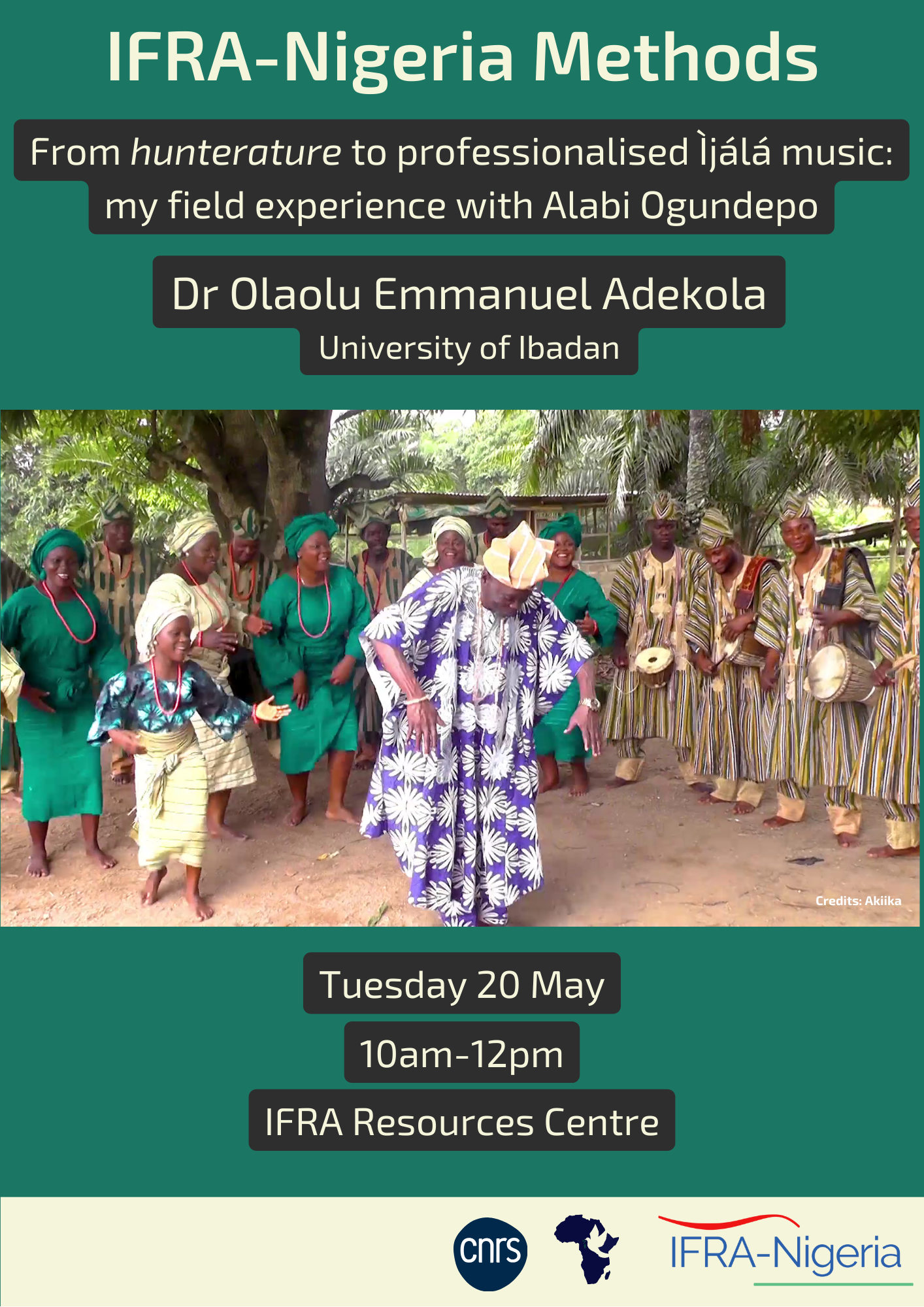 On 20 May, we welcomed Dr Olaolu Emmanuel Adekola, an ethnomusicologist from the University of Ibadan, for a Methodological Seminar on "From hunterature to professionalised Ìjálá music: my field experience with Àlàbí Ògúndépò". Delphine Manetta, IFRA-Nigeria deputy-director, opened the seminar with an introduction of Dr Adekola. A graduate of a Bachelor of Arts from Obafemi Awolowo University, he pursued a Masters of Arts and a Ph.D. in African Musicology at the Institute of African Studies (IAS), University of Ibadan. His topics of research are music education, music migration, agromusicology, and he wrote about Ìjálá and Àgídìgbo music. Today, he is a postgraduate coordinator at the IAS, and also teaches postgraduate students. He is a member of Association of Nigerian Musicologists, Society of Music Educators of Nigeria, and a fellow of Ife Institute of Advanced Studies.
Continue Reading
On Tuesday 20 May, IFRA-Nigeria welcomes Dr Olaolu Emmanuel Adekola, researcher at the Institute of African Studies in the University of Ibadan. Dr Adekola will take us through a presentation of his research into the world of Ìjálá music.
Indeed, the dynamic nature of African culture, especially Yorùbá culture, makes the study of music (a major aspect of culture) inexhaustible. Many African music have experienced changes in content, instrumentation, ensemble composition as well as performance context, meaning the researcher must adapt to the dynamism of his object of study. One of such music is Ìjálá, the hunters’ poetry, which also serves as an archiving house for Yorùbá philosophy, as performed by Alabi Ògúndépò. Dr Adekola's paper, on which his methodological presentation is based, examines how how Ìjálá music has evolved of the years and how Ògúndépò’s ingenuity, inventiveness and resilience have established the fact that modification on Ìjálá is an attempt to professionalize the art. He will detail his use of ethnographic research design, specifically with key informant interviews and observation to generate data. Finally, his paper argues that Alabi Ògúndépò’s artistic innovativeness and resilience contribute to making Ìjálá a professionalised traditional music and that his music serves as an archiving house through which human sociality and the cultural experience of Yorùbá is being re-conceived, reconstructed and re-contextualised for wider and broader usage.
Continue Reading
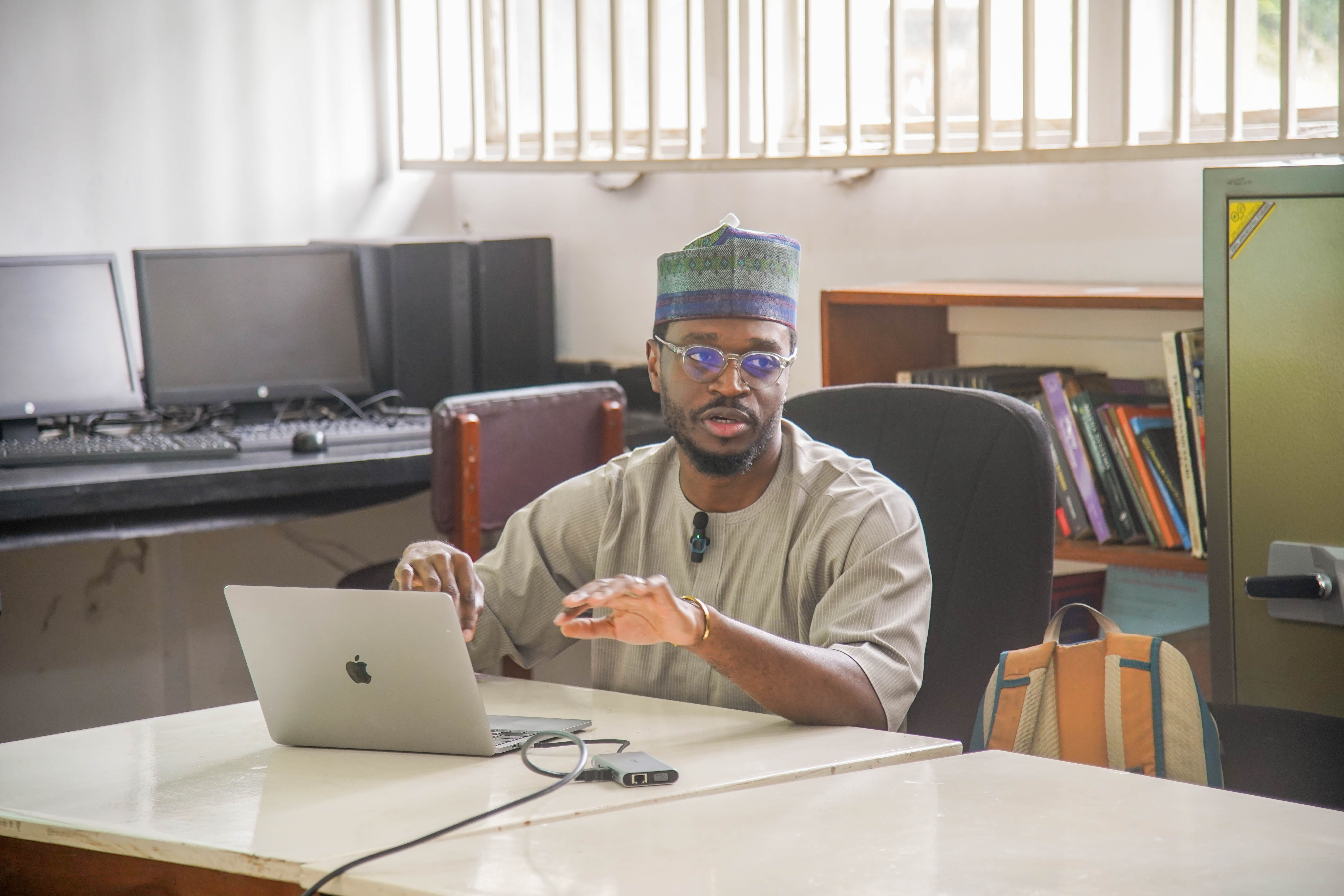 On 15 April, we welcomed Dr Sa'eed Husaini from the Centre for Democracy and Development in Abuja for our latest Methodological Seminar "On glass-eating priests and political party structures in Nigeria". Reflecting on his PhD research in Zaria and most of all Ekiti states, he highlighted how to manage positionality as a researcher in contact with political parties. Describing more specifically his own work, he also encouraged the attendants to question the dominant discourses of academia, which may not be as neutral as it appears.
Scroll below for a full summary of Dr Husaini's presentation.
Continue Reading
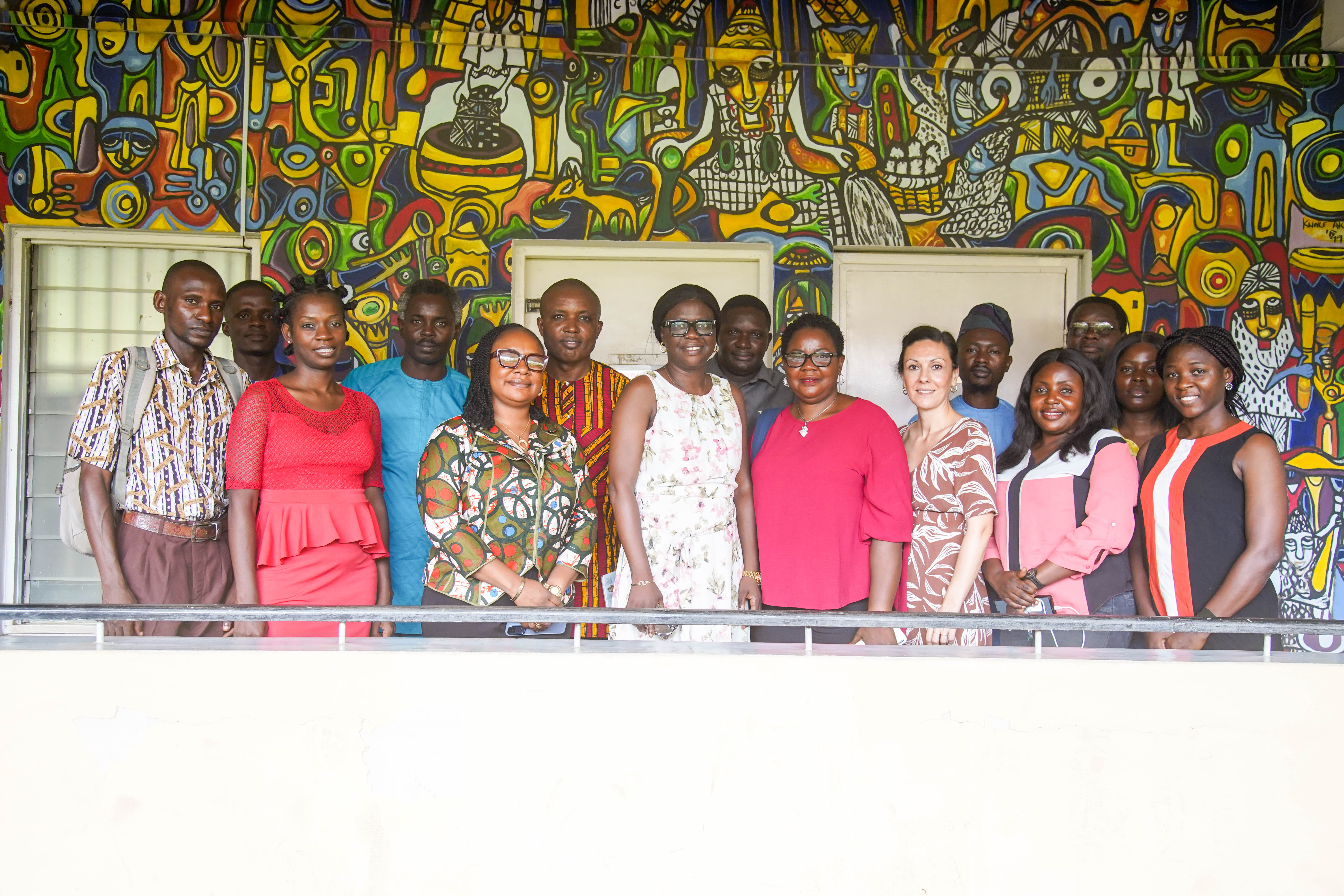 We had the pleasure to welcome Dr Abiola Ayodokun for a Methodological Seminar on 8 April, on the theme "Ethnography of gender in charcoal production". Dr Ayodokun presented the work she carried out for her PhD presentation, and the challenges she had to face to be accepted in the traditional communities she studied. She described how she needed to account for cultural sensitivities, religion and the use of working with a research assistant who could open doors.
This Seminar was a very interactive one, with fellow researchers and students sharing their questions, experiences and opinions on the topic of positionality and how to adapt to different cultural norms. You can scroll to read a full summary of Dr Ayodokun's presentation.
Continue Reading
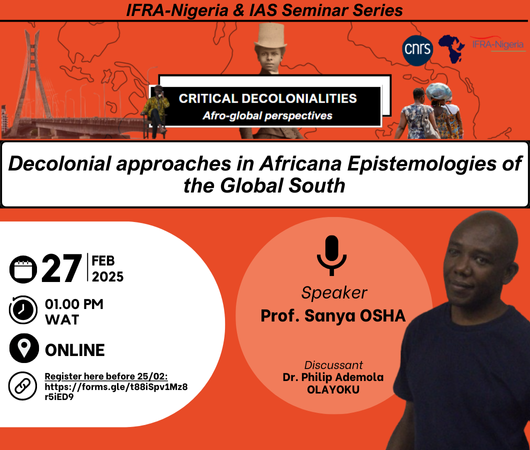 On 27 February, IFRA-Nigeria and IAS were proud to welcome Professor Sanya Osha (African Studies Centre Leiden & ZMO Berlin) and Dr Philip Ademola Olayoku (University of Ibadan) as his discussant for an exploration of the philosophy of decolonialism on the theme "Decolonial approaches in Africana espistemologies of the global South". Prof. Osha presented a historical overview of decolonialism in philosophy, emphasizing its African roots alongside its Latin American development. His discussion centered on three influential African philosophers—Kwasi Wiredu, Paulin Hountondji, and Olabiyi Babalola Yai.
He first talked of Wiredu, who is often regarded as the greatest African philosopher of his generation, and his theory of ‘conceptual decolonization', inspiring comparisons of Western and indigenous philosophies through epistemological and linguistic analysis. His contemporary, Hountondji, was a critic of the relativism of ‘ethnophilosophy' and sought to reconcile universalism with local knowledge through the concept of 'endogenous knowledge.' Finally, Prof. Osha discussed the work of a man he worked with extensively on the UNESCO's epistemological forum project, Olabiyi Babalola Yai. In his final words, he also touched on Afro-Brazilian intellectual traditions shaped by the transatlantic slave trade.
The event concluded with a discussion between Dr Philip Ademola Olayoku and Professor Osha on language, modernity, and power dynamics in decolonialism, followed by a Q&A session on the future of decolonial thought. Click below to read a detailed summary of this seminar!
Professor Osha's full talk in now available on YouTube!
Continue Reading
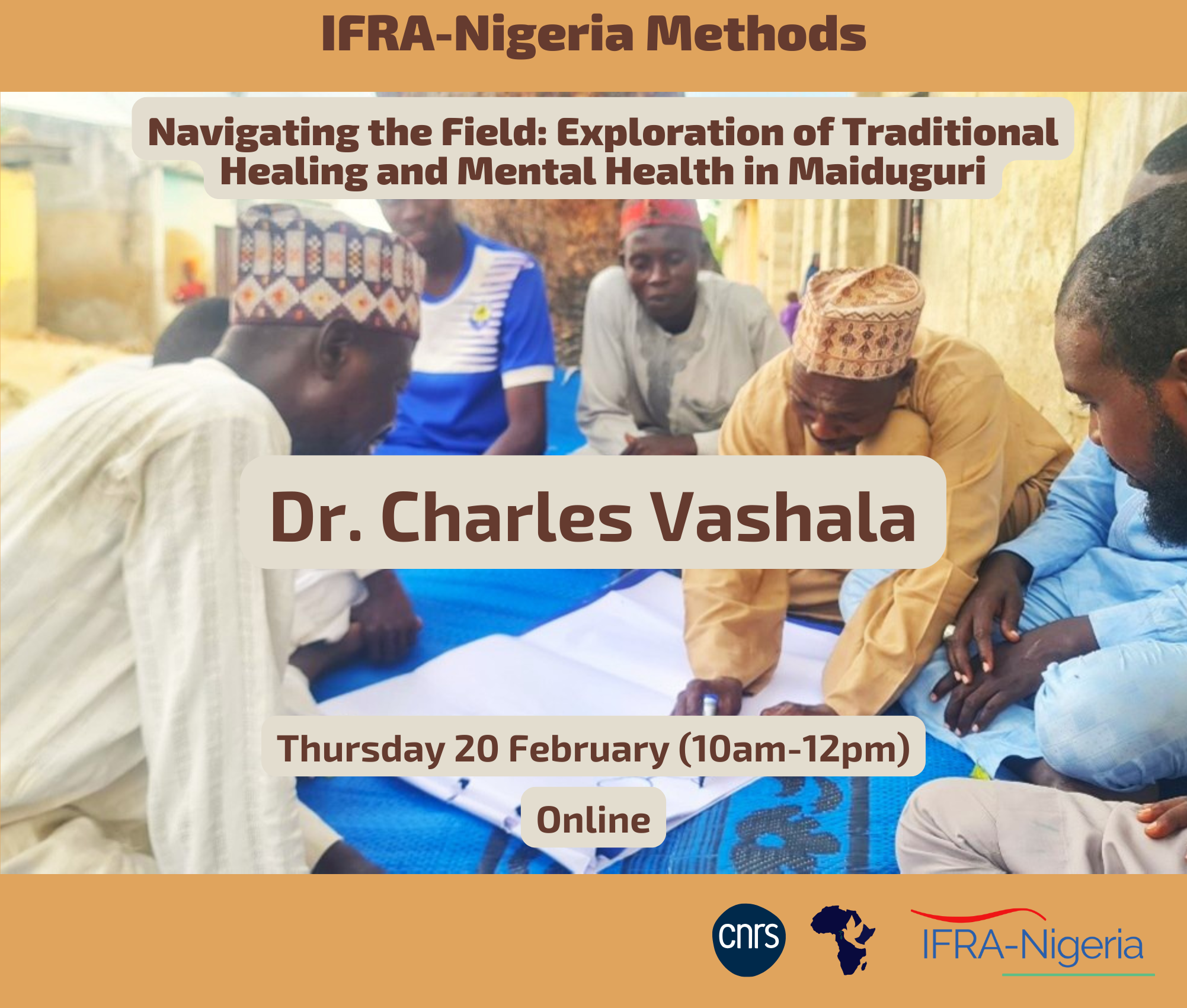 On 20 February, IFRA-Nigeria held a Methodological Seminar with Charles Vashala, researcher at the Center for the Study and Promotion of Cultural Sustainability of the University of Maiduguri and Cotutal doctoral candidate in Maiduguri and at the University of Hildesheim (Germany). He is also the recipient of an IFRA research grant. He presented the innovative methods he used for his research on the "Exploration of Traditional Healing and Mental Health in Maiduguri".
He began his presentation by presenting his research project and his goal to see it being used to bring about better policies on mental health in Borno state. He reflected on the specific challenges of access and trust while conducting research in a dangerous environment. He explained the importance of the use of partners to work around it, and the ethical challenges of needing to adapt to local beliefs and cultural practices. Finally, he explained his innovative methodology : participatory methods through drawing. A Q&A session followed the presentation.
You can find a summary of Mr. Vashala's presentation below!
Continue Reading
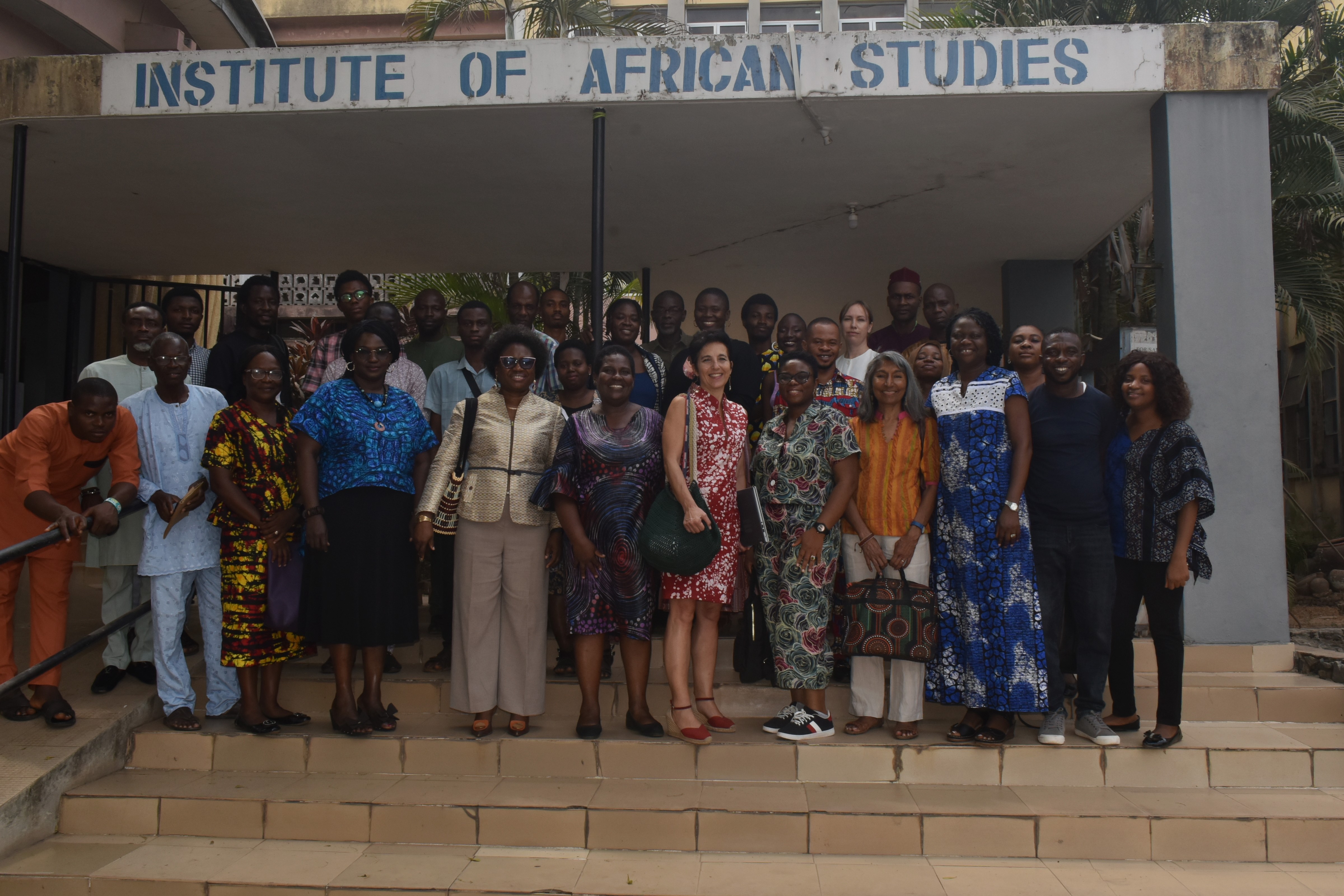 On 30 January, IFRA-Nigeria and the Institute of African Studies (IAS), hosted the first session of their seminar series on “Critical decolonialities”. The event featured Dr Charmaine Pereira, an esteemed feminist scholar based in Abuja, and Dr Oluwatoyin C. Olajide of Obafemi Awolowo University as her discussant. In her presentation, Dr Pereira focused on the general history and issues of decolonial feminism. She described the movement's role in Nigeria, through key figures like Funmilayo Ransome-Kuti and Bolanle Awe. Presenting a thorough review of the topics of feminist knowledge production in Nigeria - Boko Haram, conceptions of gender in pre-colonial societies, contesting State brutality and much more - she raised very interesting and relevant questions regarding modern challenges in Nigeria and the future of decolonial feminism. She concluded by detailing the key institutional spaces where changes can either be made or hindered.
Dr Olajide offered insightful reflections on the presentation, raising a series of questions and comments on fascinating topics like how women’s self-perception is shaped by patriarchy and colonialism, the construction of African gender and sexuality, and the recognition of some forms of domination on women’s bodies even before colonialism. Finally, the in-person and zoom participants had the opportunity to ask questions to our two speakers.
To read a more detailed summary of the event, please click below. The full conference is also available on our Youtube channel.
Continue Reading
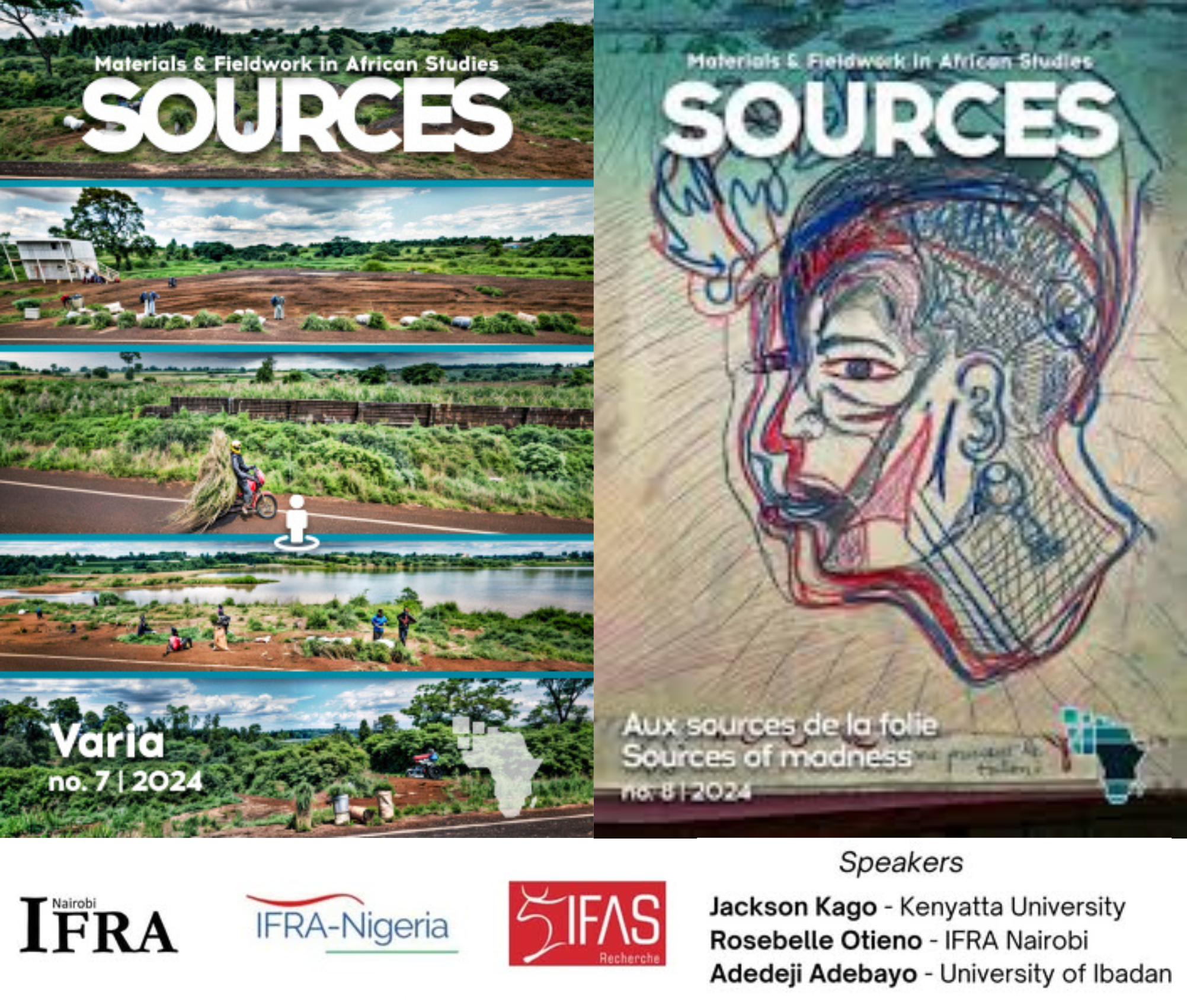 IFRA-Nigeria, IFRA-Nairobi, and IFAS Research were pleased to welcome on 23 January three esteemed collaborators - Dr Jackson Kago, Dr Adedeji Adebayo and Rosebelle Otieno - for a special webinar on the two latest issues of Sources, the free-access, double peer reviewed journal publishing African-based research by African researchers.
Both reflected on the writing of their articles, Dr Kago exploring Google Street View as a research tool and Dr Adebayo on reaching the "out of reach" in the context of his research on women's political participation in south-west Nigeria. They not only provided interesting insights on their research methods, but also practical tips for any researchers looking to publish. As for Rosebelle Otieno, she offered concrete advice on producing quality articles, based on her extensive experience in the academic publishing world. You will find a summary of this insightful webinar below.
If you're interested in learning more about Dr Kago, Dr Adebayo or Sources' work, you can find their articles as well as the journal's publication guidelines on Sources' website
Continue Reading
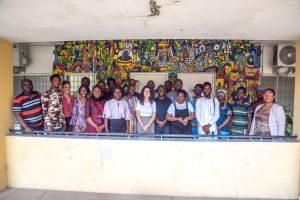 IFRA-Nigeria had the pleasure to welcome Adedeji Adebayo on 22 January, for our first Methodological Seminar of 2025. IFRA-Nigeria director, Dr Barbara Morovich, introduced Dr Adebayo, a trusted junior research associate of IFRA-Nigeria's Elections Observatory. Dr Adebayo obtained his PhD from the Peace and Conflict Department of the University of Ibadan.
During the course of his insightful presentation, he reflected on his experiences as a field or research assistant before his doctorate, and the benefit he gained from them. He argued that this allowed him to become familiar with new ways of doing research, acquire new skills and build a network of trusted researchers that continues to be very beneficial in his own work today. You will find a summary of his intervention below.
Moreover, if you're interested in learning more about Dr Adebayo's work, click here "Getting in Touch with the Out of Reach: Fieldwork Strategies in Research on Women and Politics (South-West of Nigeria)" to read his article in Sources issue n°7 "Varia".
Continue Reading

Social Media
Mailing List