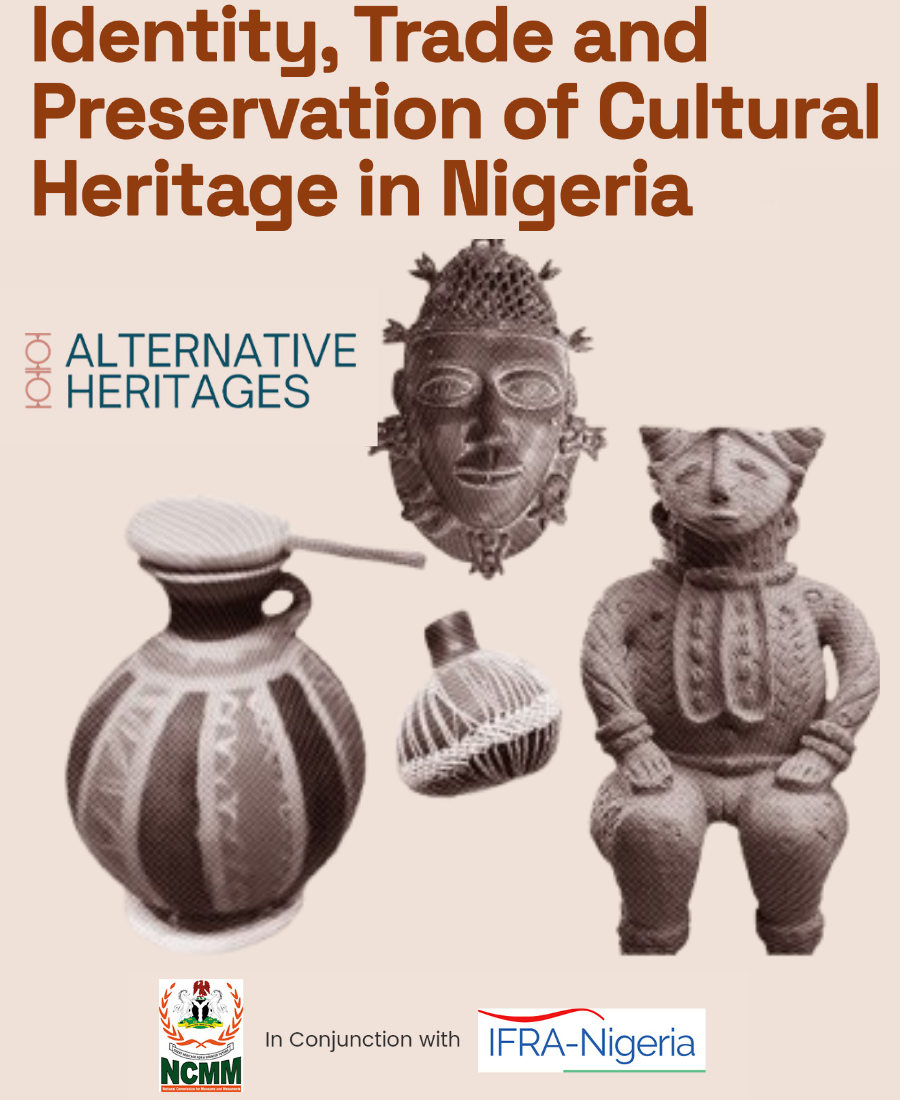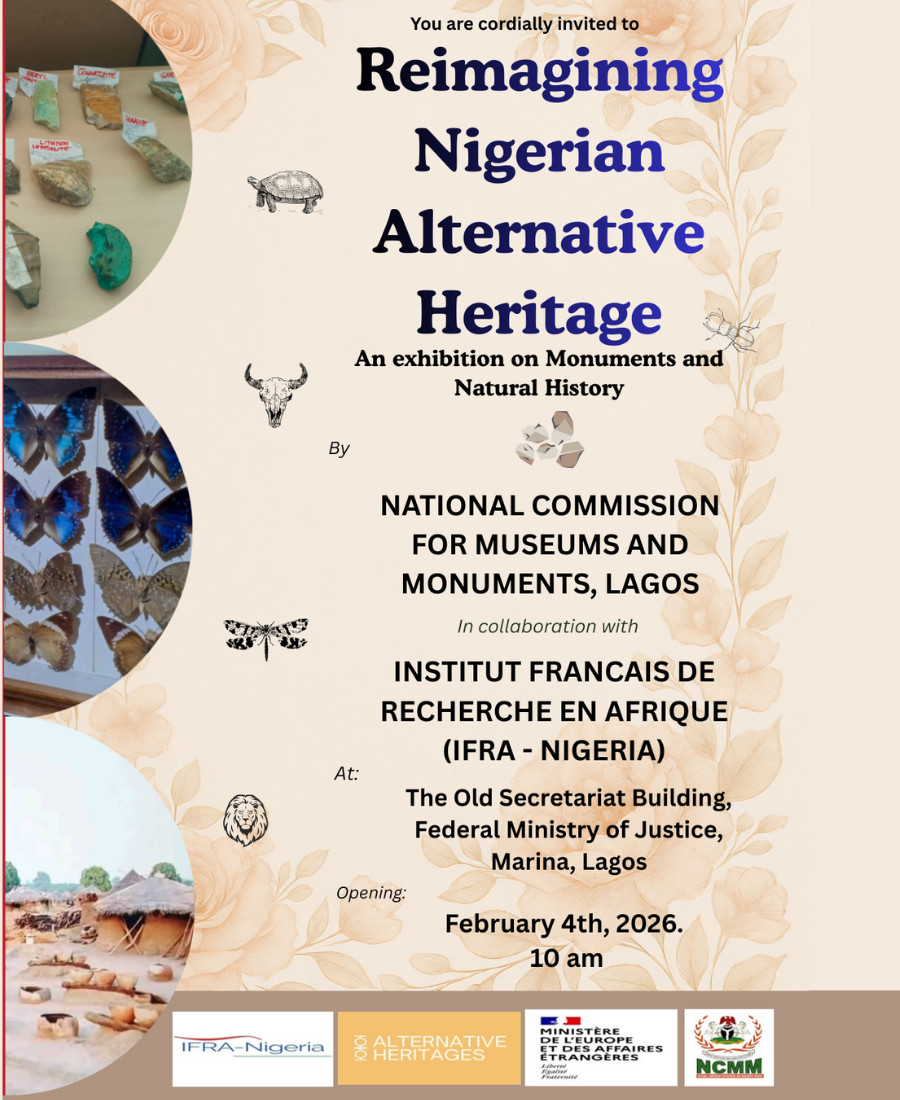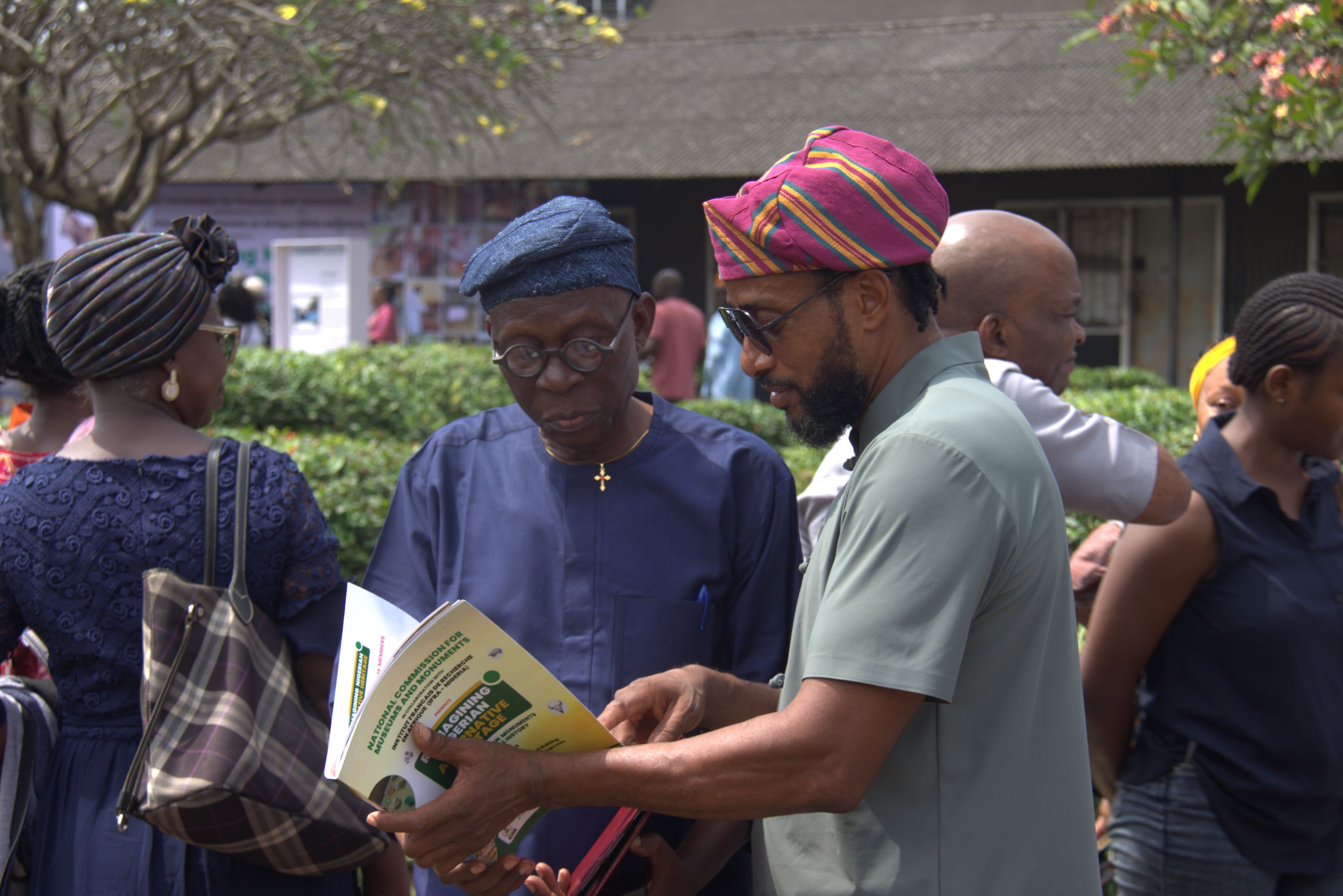
On 4 February 2026, the National Commission for Museums and Monuments, the National Museum Lagos and IFRA-Nigeria organised an exhibition on the theme "Reimagining Nigerian Alternative Heritage: An Exhibition on Monuments and Natural History". This event took place at the Old Secretariat Building, Federal Ministry, providing an historical setting, ideal to exemplify the exhibition's display of Nigerian monuments.
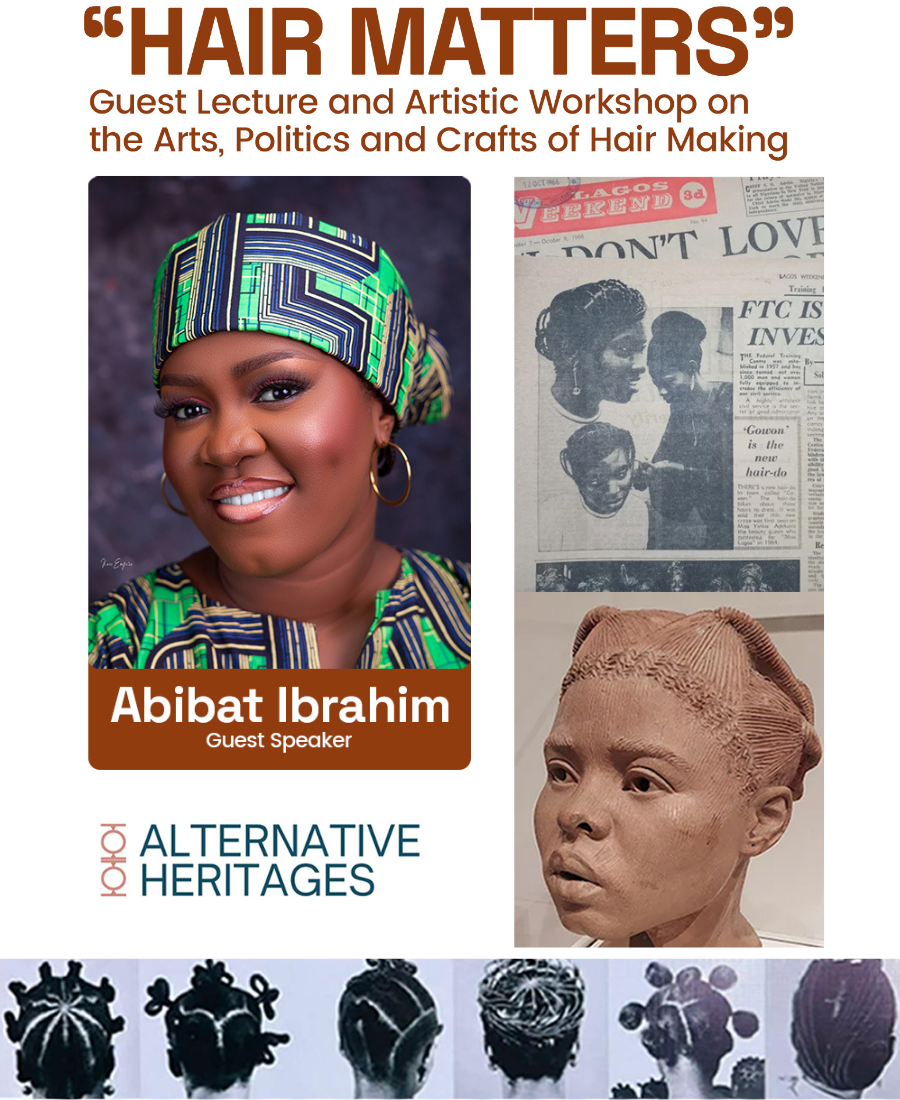
On 3 February 2026, IFRA-Nigeria in collaboration with the National Museum of Unity, Ibadan hosted an event as part of the French Embassy Fund-financed Nigeria Alternative Heritages programme. The event, with the theme "Hair Matters", was aimed at exploring the arts, crafts and politics of hair.
Between 9 and 12 February, IFRA-Nigeria held a four-day workshop on sensitive research methods, which are methods calling upon a variety of senses in order to access and share reality as it is lived and experienced. It is an approach that is deeply concerned with being ethical and collaborative throughout the fieldwork. This workshop, led by IFRA-Nigeria’s director and deputy director, Dr Pauline Guinard and Dr Delphine Manetta, was punctuated by interventions from Jean-Fidèle Ananou, photographer, Dr Altaïr Despres, writer and researcher, and sound artist Oluwaseyi Eniayo. Numerous field practices allowed students to hone their new skills.
On 19 January, 2026 the National Museum Lagos in collaboration with IFRA-Nigeria held an immersion meeting with the four successful academics who received a research grant offer from the FEF Alternative Heritages programme to discuss the four projects selected. The session brought together project leads, research fellows, and the National Museum team led by the Curator.
Between 14 and 15 January, the members of the Gender, Law and Political Activism in West Africa (GLOW) project met at the Institute of African Studies (IAS) for its final seminar. The GLOW project emphasizes multidisciplinarity to overcome methodological barriers in the study of women's legal mobilisation for gender equality in West Africa throughout the XX and XXIst centuries. By examining this history, GLOW offers a new perspective on the region's political and social history, and provides new insights into the legal construction of social inequalities.
During this seminar, researchers from Burkina Faso, France, Ghana, Italy and Nigeria gathered to discuss the various topics they worked on throughout the duration of the project. Through this writing workshop, each received feedback from the other members of the GLOW projects, as well as from a few selected University of Ibadan students who attended the event. You'll find below short summaries of each discussed papers, which will all be published in an upcoming special issue of Feminist Africa.
On 16 February 2026, the Department of Geography of the University of Ibadan welcomes IFRA-Nigeria director, Dr Pauline Guinard, to speak at the Staff and Postgraduate Students’ Seminar with a presentation titled "Experiencing Urban Transformations in Lagos Eastern Coastline". All staff, postgraduate students, and interested members of the university community are kindly encouraged to attend.
Practical information
Date: Friday, 16th January, 2026 Time: 11:00 AM Venue: SLT (Faculty of the Social Sciences, University of Ibadan)
For our virtual participants, please join the seminar using the link below:
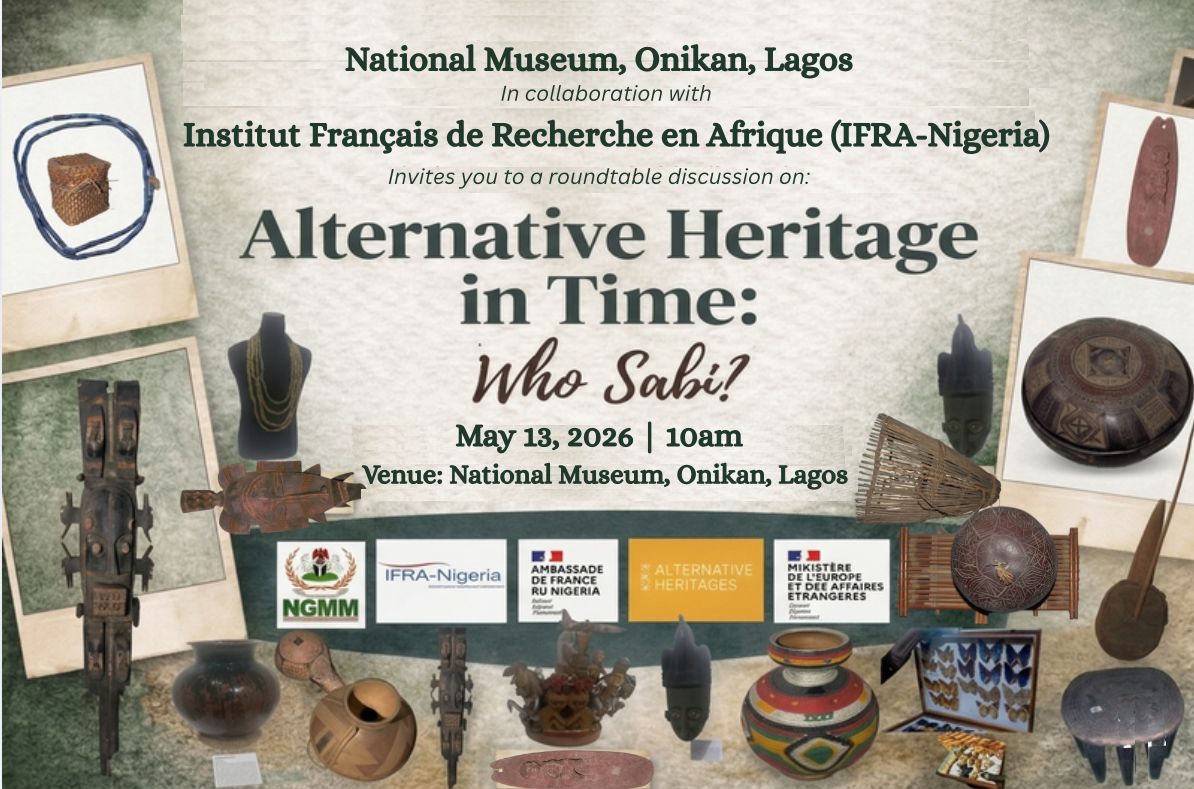
You are invited to Reimagining Nigerian Alternative Heritage: An Exhibition on Monuments and Natural History that explores the enduring relationship between Nigeria’s national monuments, natural history and the stories they continue to tell.
This exhibition reflects on how heritage is preserved, reinterpreted and passed on across generations, reminding us that culture is not static but living. Through monuments, landscapes and historical memory, you are invited to see how the past continues to shape identity and collective memory till today. This exhibition celebrates cultural exchange and inclusivity; welcoming everyone to engage with Nigeria’s rich heritage.
Join us as we reflect, learn and reconnect with histories that endure, because culture does not die; it evolves and continues to speak.
Practical information
Location: Old Secretariat Building, Federal Ministry of Justice, Marina, Lagos
Sources. Materials & Fieldwork in African Studies opened a call for abstracts on the theme "Sound Recordings". Contributions in English, French and Portuguese. This issue of Sources ambitions to bring together multiple disciplinary perspectives on one or more sound sources produced in Africa.
Sources isan interdisciplinary, multilingual, open-access peer-reviewed journal supported by the French Institutes for Research in Sub-Saharan African, including IFRA-Nigeria, and the Laboratoire des Afriques. You can read here the full call in English and the full call in French.
On 11 December 2025, we had the pleasure of hosting Dr. Moruff Mudasiru from the Department of Archaeology and Anthropology, University of Ibadan, who delivered a thought-provoking presentation titled: “Ethnography of Prayer Commodification: Field Encounters, Methodological Challenges, and Theoretical Reflections from Ibadan.”
Drawing on his ethnographic research on Jálàbí, the Islamic petitionary prayer in Ibadan, Dr. Mudasiru took us deep into the realities of fieldwork - highlighting issues of trust-building, ethical dilemmas, unexpected encounters and what it truly means to practice ethnography in complex social settings. His use of a hermeneutic theoretical framework offered rich insights into the symbolic and economic dimensions of prayer practices, making important connections to the anthropology of Islam.
For the first session of our “Imagine(d) Africa” Conference Series on 4 December 2025, the Institute of African Studies (IAS) at the University of Ibadan and IFRA-Nigeria welcomed Chrystel Oloukoï, assistant professor of geography at the University of Washington. They presented their upcoming book building on the PhD fieldwork they carried out in 2020 in Lagos during which they witnessed both the Covid curfews and the #endSARS protests. Their focus is on nighttime in the city, and the many ways in which it is policed.
Their work challenges the vision of Africa as a "night continent", "dark", or "benighted" which is prevalent in the West. It also relies on the concept of “condemnation of the night” which they define as a “naturalized set of assumptions, often animated by a racialized and feminized surplus of meaning, which produces specific “geographies of imagination” and “geographies of management”.”
IFRA-Nigeria will organize a 4-day training workshop for second year Master students and PhD students based in Ibadan, from 9 - 12 February 2026. This workshop is an opportunity to experiment and learn from the use of sensitive methods as a tool for both ethnographic investigation and research restitution.
On Wednesday, November 19, 2025, we proudly hosted our inaugural event of the second year in partnership with the National Museum of Unity in Ibadan. This 3-in-1 event featured a guest lecture, a roundtable discussion, and a hands-on exhibition, all centred around the theme "Accessible and Inclusive Public Spaces." Our goal was to spotlight the significance of cultural venues and the specific needs of individuals with disabilities in participating in cultural experiences.
Join the opening of the "Vivre le végétal en ville à Dakar, Ìbàdàn, Porto-Novo, Yaoundé" ("Living with Plants in Dakar, Ìbàdàn, Porto-Novo, and Yaoundé") at the Humathèque (Paris), on 18 December. This research-creation event marks the closing of our INFRAPATRI project, headed by former IFRA-Nigeria Deputy-Director, Dr Emilie Guitard. This exhibition explores the rich relationships between inhabitants and trees in four major African cities by bringing together the writing and art of photographers, film makers, visual artists and social science researchers produced as part of the INFRAPATRI project.
On 4 December 2025, the Institute of African Studies (University of Ibadan) and IFRA-Nigeria will hold the first conference of their Imagine(d) Africa series. Dr Chrystel Oloukoï, assistant professor of Geography at the University of Washington, received their PhD in African Studies from Harvard University in 2024 and will be the guest speaker. Their talk, entitled "Nocturnal Lagos: In the searchlight of a police cruiser" will interrogate what a (post)colonial obsession with nighttime as a spacetime of regulation, teaches us about colonial and postcolonial sovereignty.
While sex workers, gender non-conforming subjects, night revelers and low-income residents have long been the primary targets of state-sanctioned violence, the pandemic-related 2020 large scale curfews and lockdowns have expanded the scope of police brutality, and fractured the hegemony of a “security bargain” between the ruling classes and the population. Disassembling the myriad formal and informal “violence workers” which exercise at night, a hydra headed “nightwatch state”, with proliferating arms, but shaky feet, they contend that nighttime operates as a category of anxiety, displacement for nervous, paranoid states and provides a window into the nature of the contemporary “state-effect.”
"Programme Suds" is a multidisciplinary programme organized by ENS-PSL school, initiated in 2022 following a symposium at ENS. Its aim is to support, coordinate, and develop training and research on/with the Global South at ENS, but also to strengthen and build multidisciplinary research and training partnerships with institutions and researchers from the Global South. It is a collaboration between ENS, Université Cheikh Anta Diop of Dakar (Senegal), Université de Thiès (Senegal) and IFRA-Nigeria.
You can learn more about the seminars, events and student grants of this programme on their website.