
Conference "Nocturnal Lagos: In the searchlight of a police cruiser"
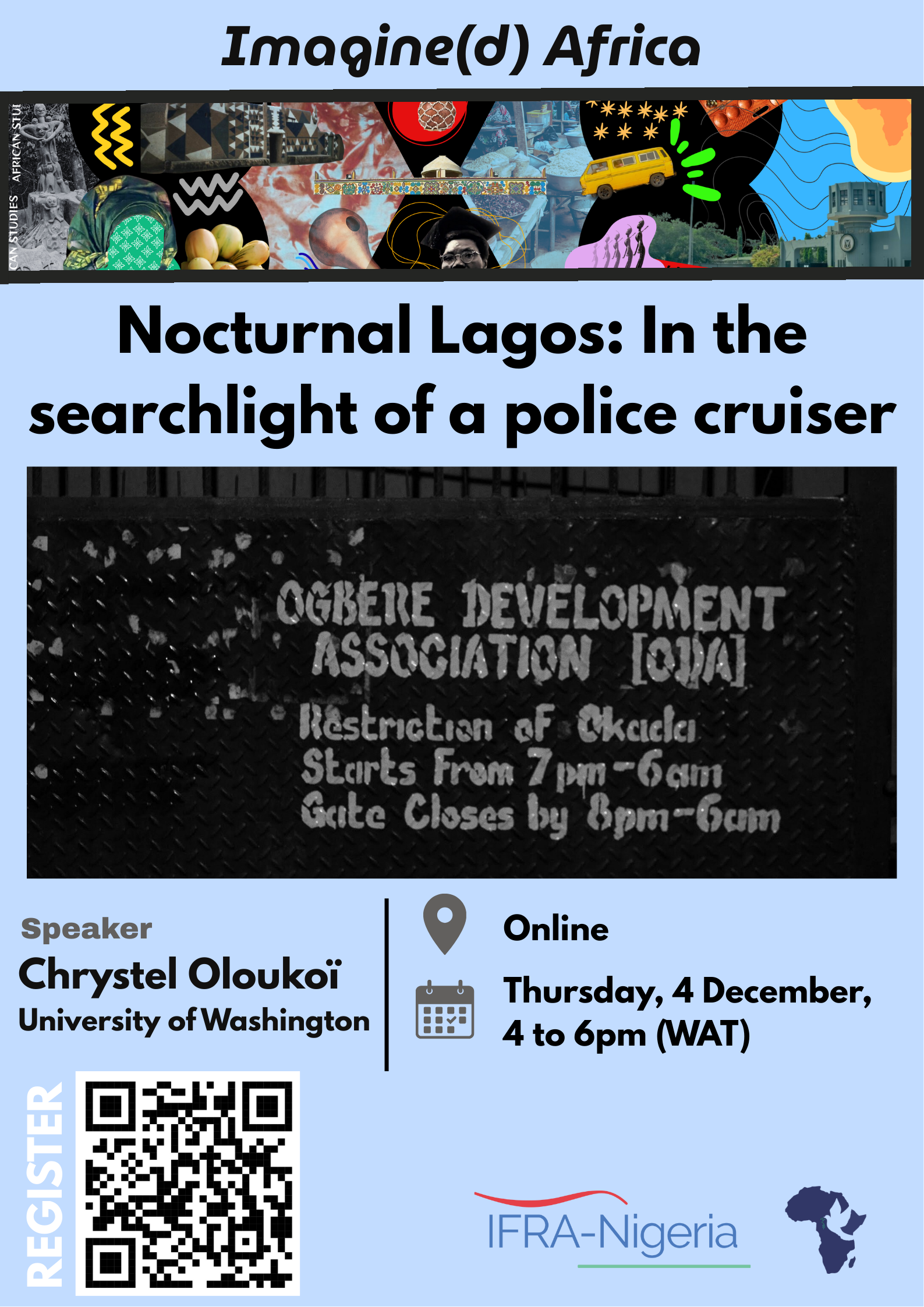 For the first session of our “Imagine(d) Africa” Conference Series on 4 December 2025, the Institute of African Studies (IAS) at the University of Ibadan and IFRA-Nigeria welcomed Chrystel Oloukoï, assistant professor of geography at the University of Washington. They presented their upcoming book building on the PhD fieldwork they carried out in 2020 in Lagos during which they witnessed both the Covid curfews and the #endSARS protests. Their focus is on nighttime in the city, and the many ways in which it is policed.
Their work challenges the vision of Africa as a "night continent", "dark", or "benighted" which is prevalent in the West. It also relies on the concept of “condemnation of the night” which they define as a “naturalized set of assumptions, often animated by a racialized and feminized surplus of meaning, which produces specific “geographies of imagination” and “geographies of management”.”
Dr Oloukoï started by highlighting the challenge of defining what is “the night”. Their archival research revealed the competing definitions of the different legal texts of the British colonial era. As a result, in practice citizens and law enforcement find a lot of leeway, and defining what is the “night” becomes a field of contestation in legal cases.
Next, they detailed their concept of the “nightwatch state” which is “a state which from the colonial to the postcolonial moment forced residents to inhabit the night only on borrowed time, always in a state of illegitimacy.” Slave trade and colonialism appear as two defining factors in the creation of the nightwatch state and the related urbanism in Lagos. The former caused the rapid expansion of cities to accommodate the trade, where curfews and night guards were put in place. The latter created complex interactions between colonial law and the British medieval history of criminalizing the nighttime. The result is the creation of temporized categories of criminalization, such as “unattached” or “nightwalker”. As pointed out by Aderinto in When Sex Threatened the State (2014), these regulations primarily impacted black women at work.
Today, the weakened police system in Nigeria led to a multi-headed state security apparatus, which also overlaps with numerous forms of private security. This situation creates a political economy of fragmentation, offering opportunities for extortion especially from sex workers, LGBTQ people and poor women at night.
The final part of Dr Oloukoï’s presentation touched on the “logic of curfew” put in place during the Covid-19 pandemic and the #endSARS process as a logical continuation of the long-running criminalization of the night. Indeed, during Covid-19, the curfew was overwhelmingly used in Nigeria, and Africa at large, compared to other countries. Next, they went back to the events of 20 October 2020 at the Lekki tollgate, during which protesters who had stayed past the 4pm curfew were shot by armed forces. The theatricality of those events - cutting the cameras and network in the area beforehand - they argue, is a flaunting of the nightwatch state’s power
Therefore, the night in Lagos is characterized by political economies based on the imaginaries surrounding nighttime, either narratives of terror or romance. Moreover, the condemnation of the night opens avenues for illegal extraction.
Dr Oloukoï’s intervention was followed by a discussion of Professor Olutayo, from the IAS.
Tags: Lagos
Social Media
Mailing List