
Between 9 and 12 February, IFRA-Nigeria held a four-day workshop on sensitive research methods, which are methods calling upon a variety of senses in order to access and share reality as it is lived and experienced. It is an approach that is deeply concerned with being ethical and collaborative throughout the fieldwork. This workshop, led by IFRA-Nigeria’s director and deputy director, Dr Pauline Guinard and Dr Delphine Manetta, was punctuated by interventions from Jean-Fidèle Ananou, photographer, Dr Altaïr Despres, writer and researcher, and sound artist Oluwaseyi Eniayo. Numerous field practices allowed students to hone their new skills.
Sensitive methods can:
- Complement other qualitative research methods, that are usually discursive, by bringing in other senses.
- Provide a fresh take on classical methods, by taking into account the emotions of the researcher and of the interlocutor. In this way it offers another type of reflexivity
- Create another temporality of research, involving listening or looking more than once at an event, and in doing so, deepening the investigation.
- Facilitate dissemination of research results to a wider audience
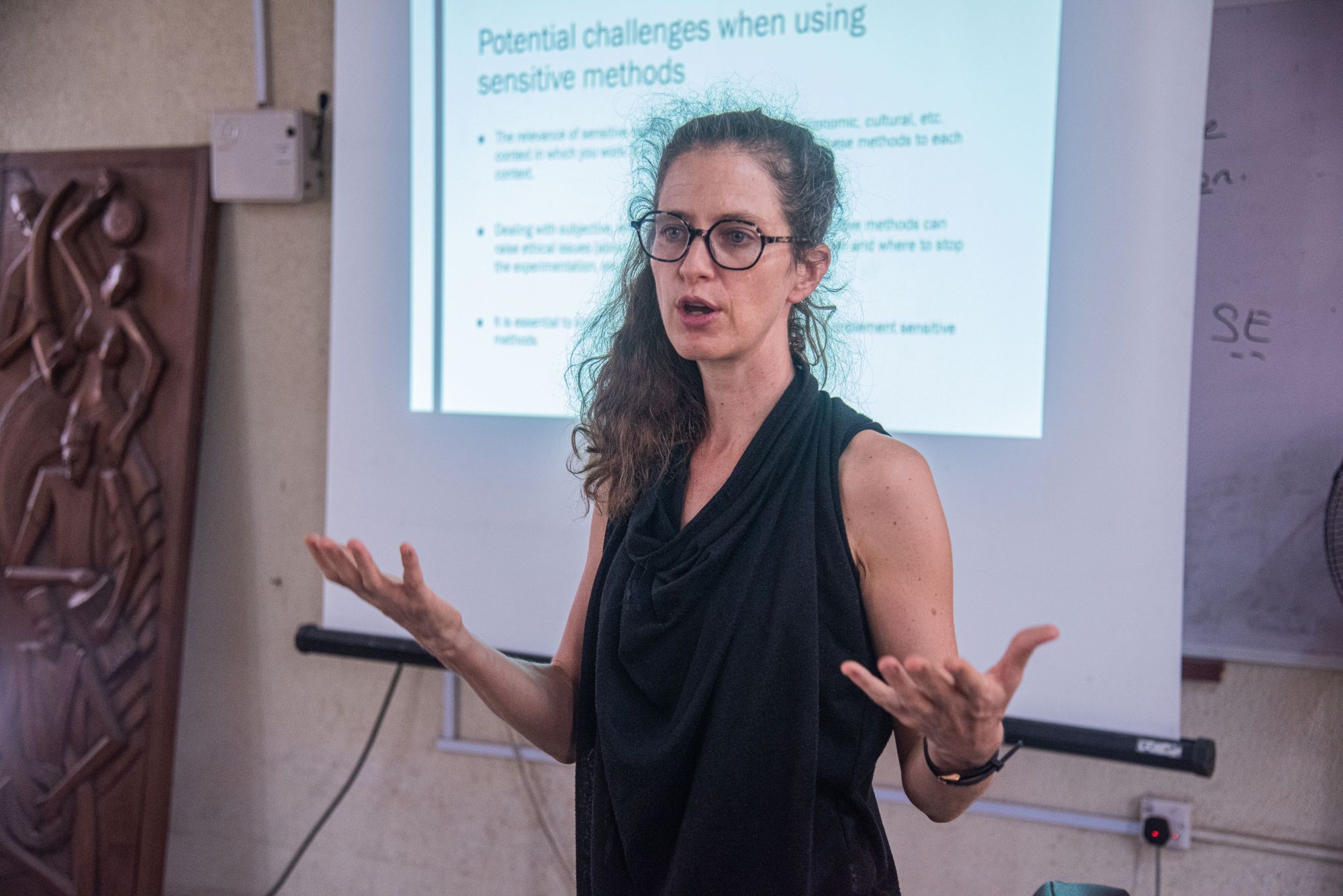
Dr Pauline Guinard introducing the concept of sensitive methods
Dr Pauline Guinard and Dr Delphine Manetta talked about their personal paths to adopting sensitive research methods. The former found that including artistic and sensitive methods allowed her to fill the lack of research on emotions in geography. For the latter, sensitive methods came through her study on masculinity, during which she came to the conclusion that the performance of masculinity, including through the relatively new value of wealth, could be best expressed with sensitive methods.
However, using sensitive research methods does involve certain challenges. Working with emotions should not be taken lightly, as certain topics can push both interviewee and interviewer’s limits. Implementing sensitive research implies an in-depth understanding of the field and the people the researcher is interested in. The researcher must also take into account the power dynamics present in the interviewer-interviewee relation, as the latter can experience it as a form of violence if it isn’t conducted ethically.
Finally, sensitive research can provide an important complement to traditional methods. However, they remain first and foremost scientific methods that must be pursued rigorously, with an accompanying critical and ethical framework.

Some example of students' pictures taken at the market
On the workshop's second day, students heard from Dr Altaïr Despres (IMAF), who studied interracial intimacy in Zanzibar. She highlighted the discrepancy between the representation of those relationships in popular media, which often present a short-term connection between an older Western woman with a young African man, and the reality which often involves pairs of similar age and regularly become long term partnerships.
Out of her fieldwork, she wrote a novel, Zanzibar, which she describes as both an anthropological and literary text. It allowed her to explore both the context of the situation, to explain behaviors without condemnation, and most of all to emphasize the emotions of her protagonists/subject of interest, which is normally nearly entirely absent from scientific texts. Similarly, through her writing she transmits the smells, sensations and landscapes of Zanzibar, immersing the reader in its atmosphere.
To her, literary writing allows an “emancipation from the regime of proof” by removing the obligation to demonstrate your thesis. This new way of using research allowed her to emphasize what she was feeling during her fieldwork, something that is often stripped of a scientific paper. Moreover, literature can reach a wider and more diverse audience than anthropology can. As a result, she also received a lot more feedback on her work.
Next, Jean-Fidèle Ananou, a Lagos-based photographer, introduced students to photography. In particular, he highlighted the importance of adopting an ethical approach to photography, both by asking for consent but also by understanding common narratives on certain topics and making an educated decision on deciding whether to further them or challenge them. Taking vulnerability into account is paramount for photography.
On the third day, we welcomed sound artist Oluwaseyi Eniayo for a presentation on "Sound, Responsibility, and the Ethics of Attention”. He explained that sound captures atmosphere, emotion, relation and can reveal what evades writing. It can also be both a method of investigation and a form of restitution. Adopting an ethical approach is again crucial, it is important to respect refusal, and to clearly explain your purpose to participants.
Each afternoon involved a practice session for students at the Ibadan central train station, during which they implemented the day’s lesson. The fourth and final day was dedicated to group work, during which participants chose a theme related to the Ibadan bus station, and based on it captured a picture, a sound and wrote a research question. The groups restituted their presentation of their chosen theme – the market, space, gender and health – and each received feedback from the researchers and other participants.
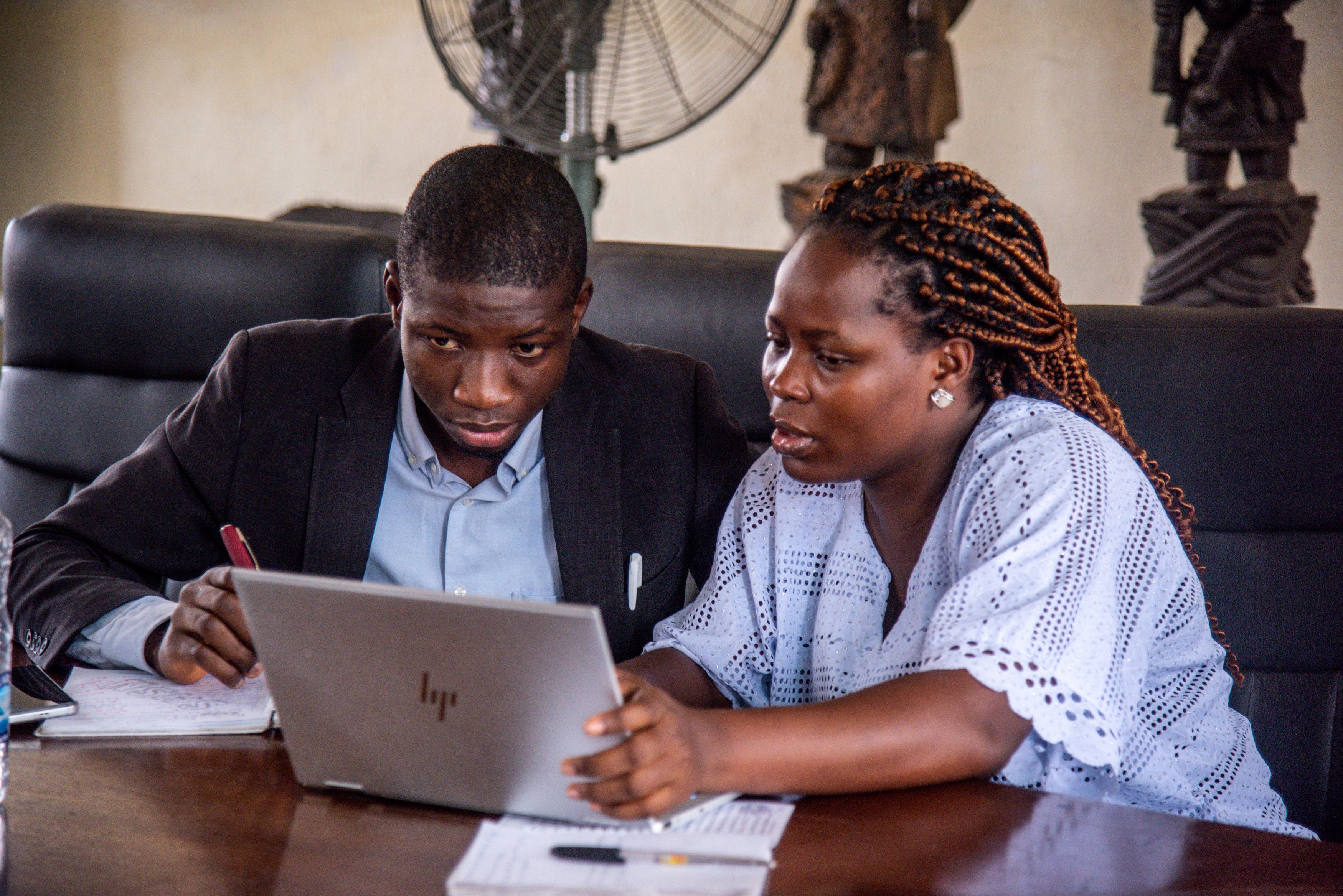
Participants to the workshop